Walk into any gym, scroll social media for five minutes, or listen to the latest health podcast and you’ll hear the same message:
Lose weight.
Build muscle.
Run a marathon.
Try this supplement.
Follow this diet.
The problem?
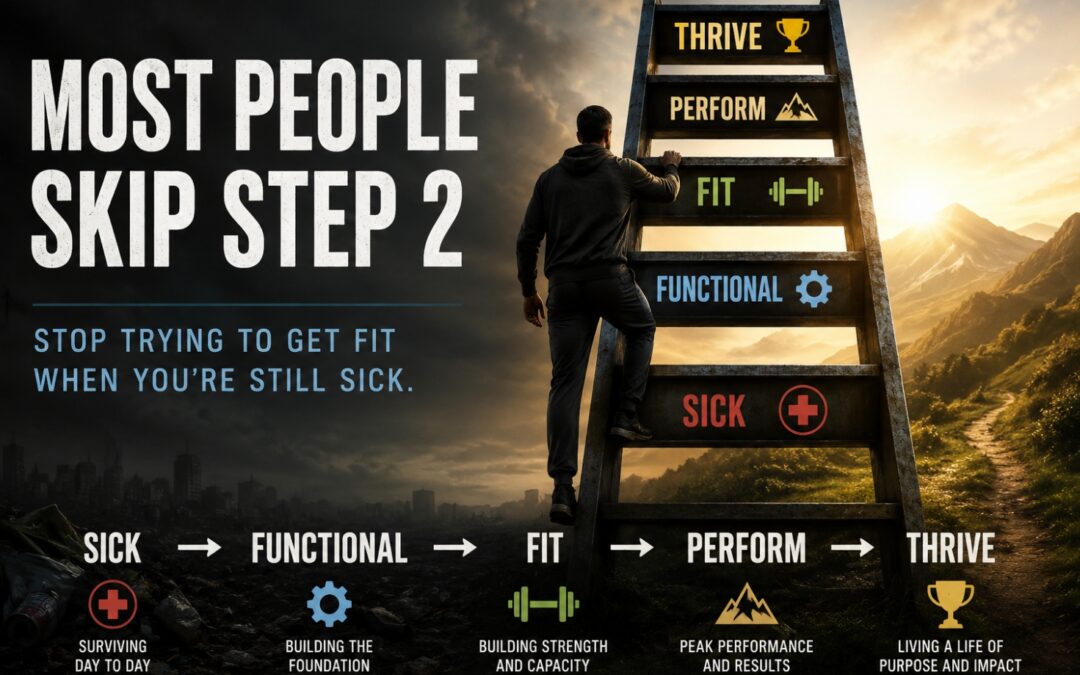
Most people are trying to get fit before they’ve become functional.
That’s like trying to run a 5K before you’ve learned how to walk around the block without getting winded.
As a nutritionist for more than 20 years, I’ve seen this mistake over and over again. People jump straight into advanced fitness goals while ignoring the foundational issues that are preventing them from feeling and performing their best.
I believe the journey should look like this:
Sick → Functional → Fit → Perform → Thrive
Let’s break that down.
Stage 1: Sick
This doesn’t necessarily mean you’re diagnosed with a disease.
Many people are “sick” long before they ever receive a diagnosis.
Signs you may be stuck here include:
- Constant fatigue
- Brain fog
- Poor sleep
- Digestive issues
- Frequent cravings
- Excess body fat
- Elevated blood sugar
- High triglycerides
- Chronic inflammation
- Reliance on caffeine to get through the day
Unfortunately, many people think these symptoms are normal.
They’re not.
They’re signals.
Your body is communicating that something isn’t working properly.
The good news is that symptoms are often reversible when you address the underlying habits driving them.
Stage 2: Functional
This is the stage nobody talks about.
Everyone wants to be fit.
Nobody wants to be functional.
But function is where health begins.
A functional person may not have visible abs or run ultramarathons, but they have:
- Stable energy
- Improved sleep
- Better digestion
- Consistent eating habits
- Healthier bloodwork
- Better recovery
- Fewer cravings
- Improved stress management
In other words, their body is doing what it’s designed to do.
This is where one of my favorite concepts comes into play:
Food is information.
Many people think food is simply calories.
Calories matter, but food does much more than provide energy.
Every meal sends signals throughout your body.
Protein tells your body to repair and maintain muscle.
Fiber supports your gut bacteria.
Omega-3 fats influence inflammation.
Micronutrients support countless processes involved in energy production, recovery, and overall health.
Food doesn’t act like a drug.
Food provides instructions.
Your body then responds to those instructions.
That’s why I often tell people:
Every bite of food is a vote for the version of yourself you’re becoming.
Stage 3: Fit
Once your body is functioning properly, now we can start talking about fitness.
This is where goals become more performance-oriented:
- Building muscle
- Losing body fat
- Improving conditioning
- Increasing strength
- Running races
- Participating in sports
The key difference?
You’re building on a solid foundation.
Instead of fighting your body every step of the way, you’re working with it.
Your energy is better.
Recovery improves.
Training becomes more productive.
Results come easier.
Why Bloodwork Matters
One of the biggest mistakes people make is waiting until they feel terrible before paying attention to their health.
Bloodwork allows us to see dysfunction before it becomes disease.
Markers like:
- Fasting glucose
- Hemoglobin A1c
- Triglycerides
- HDL cholesterol
- Liver enzymes
- Inflammatory markers
can provide valuable insight into what’s happening beneath the surface.
Think of bloodwork as a report card.
If food is information, bloodwork tells us how your body is responding to that information.
It provides objective feedback instead of relying solely on symptoms.
Practical Steps to Move from Sick to Functional
You don’t need a perfect diet.
You don’t need expensive supplements.
You don’t need to spend two hours a day in the gym.
Start here:
- Eat protein at every meal.
- Drink more water.
- Walk daily.
- Eat vegetables regularly.
- Prioritize sleep.
- Reduce ultra-processed foods.
- Get basic bloodwork completed annually.
- Be consistent more often than you’re perfect.
Simple isn’t sexy.
But simple works.
The Bottom Line
Most people are trying to jump from sick to fit.
The real path looks different.
Sick → Functional → Fit → Perform → Thrive
Before you chase abs, marathons, or personal records, make sure your body is functioning properly.
Because when your body functions well, fitness becomes easier.
And when fitness becomes easier, performance follows.
Start where you are.
Build the foundation.