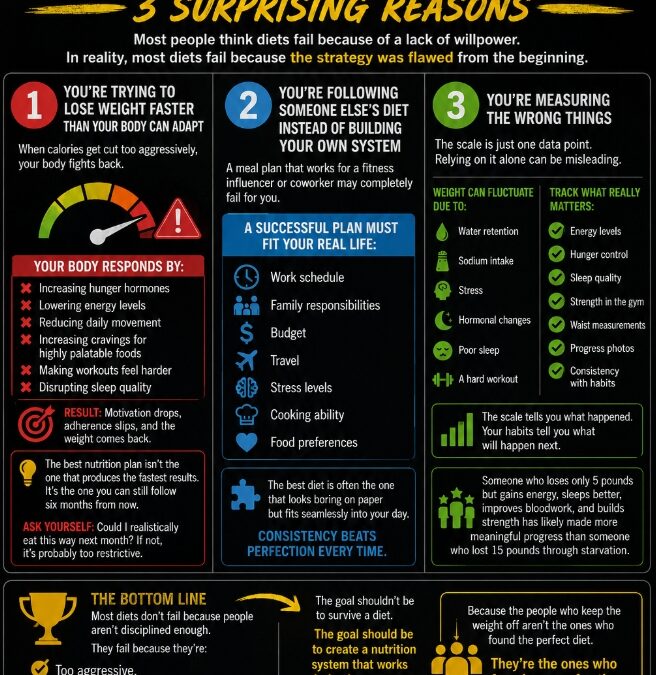
Most people think diets fail because of a lack of willpower.
In reality, most diets fail because the strategy was flawed from the beginning.
Here are three reasons that catch people off guard:
1. You’re Trying to Lose Weight Faster Than Your Body Can Adapt
The fitness industry rewards quick results.
“Lose 20 pounds in 30 days.”
“Drop two sizes in six weeks.”
“Burn fat fast.”
The problem? Your body doesn’t care about marketing.
When calories get cut too aggressively, your body responds by:
- Increasing hunger hormones
- Lowering energy levels
- Reducing daily movement
- Increasing cravings for highly palatable foods
- Making workouts feel harder
- Disrupting sleep quality
The result is predictable: motivation drops, adherence slips, and the weight comes back.
The best nutrition plan isn’t the one that produces the fastest results.
It’s the one you can still follow six months from now.
Ask yourself: Could I realistically eat this way next month? If not, it’s probably too restrictive.
2. You’re Following Someone Else’s Diet Instead of Building Your Own System
A meal plan that works for a fitness influencer, bodybuilder, or coworker may completely fail for you.
Why?
Because they don’t live your life.
A successful nutrition strategy must account for:
- Work schedule
- Family responsibilities
- Budget
- Travel
- Stress levels
- Cooking ability
- Food preferences
For example:
An Executive Director working 10-hour shifts probably needs convenience options.
A parent with three kids needs flexibility.
A night-shift worker needs a completely different eating schedule than a 9-to-5 employee.
The best diet is often the one that looks boring on paper but fits seamlessly into your day.
Consistency beats perfection every time.
3. You’re Measuring the Wrong Things
Most people only track one metric:
The scale.
The problem is that body weight can fluctuate several pounds from:
- Water retention
- Sodium intake
- Stress
- Hormonal changes
- Poor sleep
- A hard workout
If the scale is your only measure of success, you’re going to feel like you’re failing even when you’re making progress.
Instead, monitor:
- Energy levels
- Hunger control
- Sleep quality
- Strength in the gym
- Waist measurements
- Progress photos
- Consistency with habits
Someone who loses only 5 pounds but gains energy, sleeps better, improves bloodwork, and builds strength has likely made more meaningful progress than someone who lost 15 pounds through starvation.
The scale tells you what happened.
Your habits tell you what will happen next.
The Bottom Line
Most diets don’t fail because people aren’t disciplined enough.
They fail because they’re:
- Too aggressive.
- Built for someone else’s lifestyle.
- Measured by the wrong outcomes.
The goal shouldn’t be to survive a diet.
The goal should be to create a nutrition system that works during busy seasons, stressful weeks, vacations, holidays, and real life.
Because the people who keep the weight off aren’t the ones who found the perfect diet.
They’re the ones who found a way of eating they never had to quit.
Remember:
- Calories decide weight.
- Macros decide body composition.
- Food quality decides how you feel.
- Consistency determines whether any of it matters.