We have all been overwhelmed.
Work is piling up. The calendar is full. People need things from you. There are responsibilities at home. Bills still have to be paid. Your family needs you. Your career needs you. And somewhere in the middle of all of it, you are supposed to take care of yourself too.
Eventually, it can feel like there simply isn’t enough of you to go around.
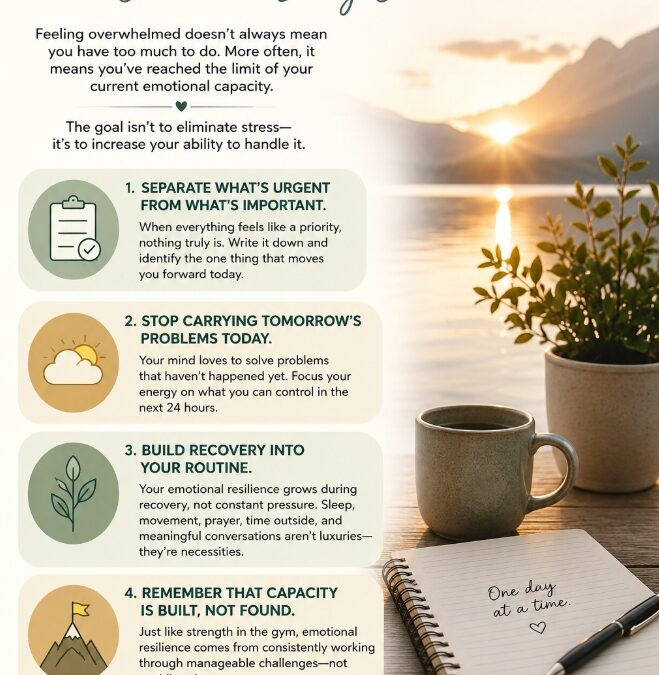
But feeling overwhelmed doesn’t always mean you have too much to do.
Sometimes it means you have reached the limit of your current emotional capacity.
There is an important difference.
We talk a lot about building physical capacity. If you want to become stronger, you progressively challenge your muscles. If you want better cardiovascular fitness, you gradually increase the amount of work your heart and lungs can handle.
We understand that capacity can be trained physically.
Mental and emotional capacity can be built too.
The goal shouldn’t be to create a life without stress. That’s probably not realistic.
The goal is to become better equipped to handle the stress that comes with the life you’re trying to build.
What Is Emotional Capacity?
Think of emotional capacity as your ability to experience stress, pressure, disappointment, uncertainty, conflict, and responsibility without allowing those things to completely consume you.
Two people can experience the exact same situation and respond very differently.
That doesn’t necessarily mean one person is tougher than the other.
Their current capacity may simply be different.
Sleep matters. Nutrition matters. Relationships matter. Previous stress matters. Financial pressure matters. Workload matters. Your support system matters.
And when enough of those stressors start stacking on top of each other, even someone who normally handles pressure incredibly well can become overwhelmed.
This is why mental health isn’t something we should only talk about when someone reaches a breaking point.
We need to become proactive instead of reactive.
We need to build capacity before we desperately need it.
1. Separate What’s Urgent From What’s Important
One of the fastest ways to become overwhelmed is to convince yourself that everything needs your attention right now.
It doesn’t.
When your brain sees 15 problems at the same time, it often treats all 15 like emergencies.
The email feels urgent.
The project feels urgent.
The dishes feel urgent.
The financial decision feels urgent.
The conversation you need to have next week somehow feels urgent today.
Before long, your brain is trying to solve your entire life at once.
You can’t.
Instead, ask yourself:
What actually requires my attention today?
Write everything down. Get it out of your head and somewhere you can see it.
Then prioritize.
There may still be ten things that need to get done eventually, but there might only be two that truly matter today.
Handle those two.
Mental clarity often begins when we stop demanding that our brain hold every responsibility simultaneously.
2. Stop Carrying Tomorrow’s Problems Today
This one is difficult.
Especially for planners.
We naturally want to know what’s coming. We want certainty. We want to know how the situation is going to work out.
But life doesn’t always give us that.
So we start creating scenarios.
What if this happens?
What if that doesn’t work?
What if something goes wrong?
What if I make the wrong decision?
Now you’re experiencing the emotional consequences of something that hasn’t even happened.
That’s exhausting.
Planning for the future is responsible.
Living emotionally in the future is different.
Sometimes the healthiest thing you can do is shrink your world down to the next 24 hours.
What can I control today?
What conversation can I have today?
What decision can I make today?
What action can I take today?
Then let tomorrow have tomorrow’s problems.
3. Build Recovery Into Your Routine
We have glorified constantly being busy.
More work.
More productivity.
More responsibilities.
More training.
More everything.
Then we wonder why people are mentally exhausted.
You cannot constantly withdraw from your emotional bank account without eventually making a deposit.
Recovery isn’t weakness.
It is part of performance.
That recovery may look different for everyone.
It might be exercise.
It might be walking outside without your phone.
It might be prayer.
It might be sitting quietly for ten minutes before everyone else wakes up.
It might be talking to your spouse, a friend, counselor, pastor, or someone you trust.
It might simply be getting eight hours of sleep.
The activity itself isn’t as important as creating intentional periods where your nervous system isn’t being asked to perform.
We understand this with physical training.
You wouldn’t train the same muscle at maximum intensity every hour of every day and expect it to continue performing.
Why do we expect our minds to?
4. Stop Treating Emotions Like a Weakness
This is something I believe we need to talk about more.
Feeling something doesn’t make you weak.
Being stressed doesn’t make you weak.
Being scared doesn’t make you weak.
Crying doesn’t make you weak.
Admitting that you’re struggling doesn’t make you weak.
You can be strong and overwhelmed.
You can be successful and anxious.
You can be grateful for your life and still struggle with parts of it.
Those things can exist at the same time.
The problem comes when we spend so much energy pretending we’re fine that we never actually deal with what we’re carrying.
Mental health isn’t about eliminating emotion.
It’s about learning how to understand it, process it, communicate it, and continue moving forward in a healthy way.
Sometimes strength means pushing through.
Sometimes strength means admitting that something needs to change.
And sometimes strength means asking someone else to help you carry it.
5. Control What You Can Control
Overwhelm thrives on uncertainty.
There are going to be situations you simply cannot control.
You cannot control other people’s decisions.
You cannot control every outcome.
You cannot control everything that happens at work.
You cannot control the economy.
You cannot control the past.
And you certainly cannot control every challenge that life is going to put in front of you.
But you can control your response.
You can control your habits.
You can control whether you move your body today.
You can control what you eat.
You can control whether you communicate.
You can control whether you ask for help.
You can control where you put your attention.
When life feels enormous, bring your focus back to the things you actually have influence over.
Small actions restore a sense of control.
And sometimes that is exactly what your mind needs.
6. Remember That Capacity Is Built, Not Found
You don’t wake up one morning magically resilient.
Capacity is built through experience.
You face something difficult.
You work through it.
You recover.
You learn.
Then the next challenge comes.
And eventually you realize something important:
Things that once overwhelmed you don’t overwhelm you anymore.
Not because life necessarily became easier.
Because you became more capable.
That’s growth.
The goal isn’t to avoid every difficult situation. If we remove every challenge, we also remove many of the opportunities that develop resilience.
The goal is manageable adversity followed by intentional recovery.
Challenge.
Adapt.
Recover.
Grow.
It’s remarkably similar to physical training.
You Don’t Have to Carry Everything at Once
If you’re overwhelmed right now, you don’t have to solve your entire life today.
Start smaller.
Take care of your body.
Get some sleep.
Move.
Eat something that supports you.
Pray.
Have the conversation you’ve been avoiding.
Write down what’s actually bothering you.
Ask for help when you need it.
Then identify the next thing you can control and take one step forward.
Mental health deserves the same attention we give physical health.
We shouldn’t wait until someone is completely depleted before we tell them recovery matters.
We shouldn’t wait until someone breaks before we tell them it’s okay to talk.
And we shouldn’t define strength as someone’s ability to silently carry an unlimited amount of weight.
Overwhelm isn’t always a sign that you need to do less.
Sometimes you absolutely do need to remove something from your plate.
But other times, it’s an opportunity to build the emotional capacity necessary for the next version of your life.
Because the goal isn’t to become someone who never feels overwhelmed.
The goal is to become someone who knows what to do when they are.