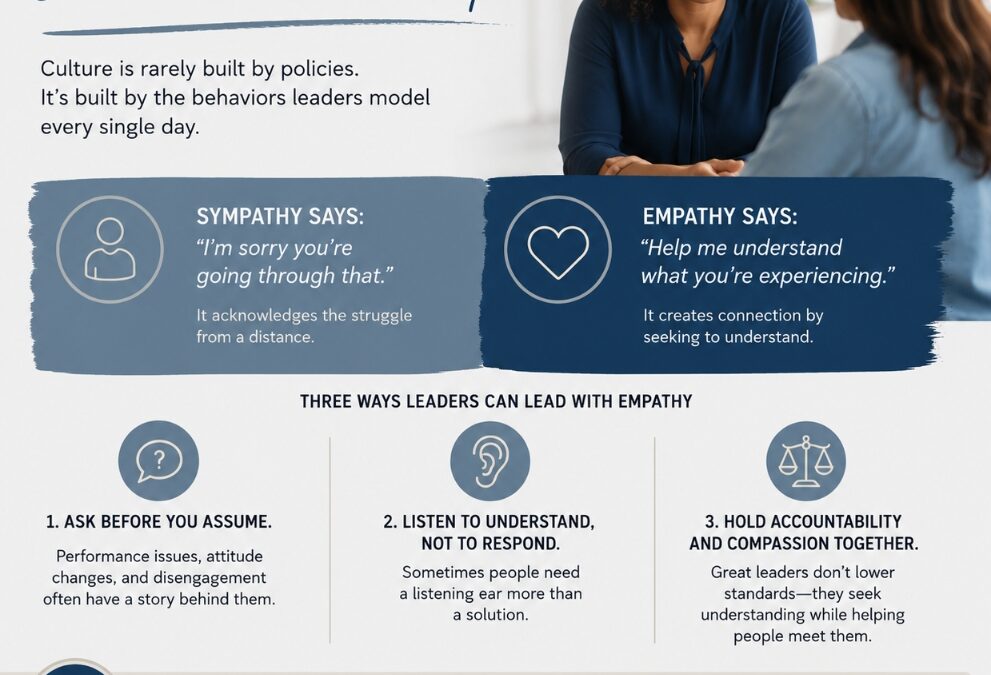
Culture is rarely built by mission statements, policies, or employee handbooks.
It’s built by the behaviors leaders model every day.
Every interaction, every conversation, every response to adversity sends a message about what kind of culture exists within an organization. Employees pay far less attention to what leaders say and far more attention to what leaders consistently do.
One of the most overlooked culture-building behaviors is the difference between sympathy and empathy.
While the two terms are often used interchangeably, they create vastly different experiences for employees.
Sympathy Says:
“I’m sorry you’re going through that.”
Empathy Says:
“Help me understand what you’re experiencing.”
At first glance, the difference seems subtle.
In reality, it changes everything.
Sympathy acknowledges someone’s struggle from a distance.
Empathy steps into the struggle with them.
Sympathy often ends the conversation.
Empathy begins one.
Employees rarely expect leaders to solve every challenge they face. Most understand that workplace realities include deadlines, staffing shortages, personal hardships, family stressors, and unexpected obstacles.
What employees do expect is to feel seen.
They want to know that their leaders care enough to understand what they’re experiencing before making assumptions or judgments.
When people feel understood, trust grows.
When trust grows, engagement follows.
When engagement follows, culture improves.
The strongest workplace cultures aren’t built because leaders have all the answers.
They’re built because employees know their leaders genuinely care enough to listen.
Why Empathy Matters More Than Ever
Today’s workforce is carrying more than what shows up on a schedule or job description.
Employees are navigating:
- Family responsibilities
- Financial stress
- Caregiving duties
- Health concerns
- Mental and emotional fatigue
- Relationship challenges
- Grief and loss
The reality is that what appears to be a performance issue may actually be a personal struggle.
What appears to be disengagement may actually be exhaustion.
What appears to be a poor attitude may actually be someone silently carrying a burden nobody knows about.
Empathy doesn’t excuse poor performance.
It helps leaders understand the context before addressing it.
The goal isn’t to lower standards.
The goal is to understand the human being behind the behavior.
Three Ways Leaders Can Lead with Empathy Today
1. Ask Before You Assume
Most leaders are trained to identify problems quickly.
The danger is that we often create explanations before gathering information.
An employee who has become withdrawn may be struggling with a sick parent.
A team member who is missing deadlines may be overwhelmed outside of work.
A normally positive employee who suddenly seems frustrated may be dealing with circumstances nobody sees.
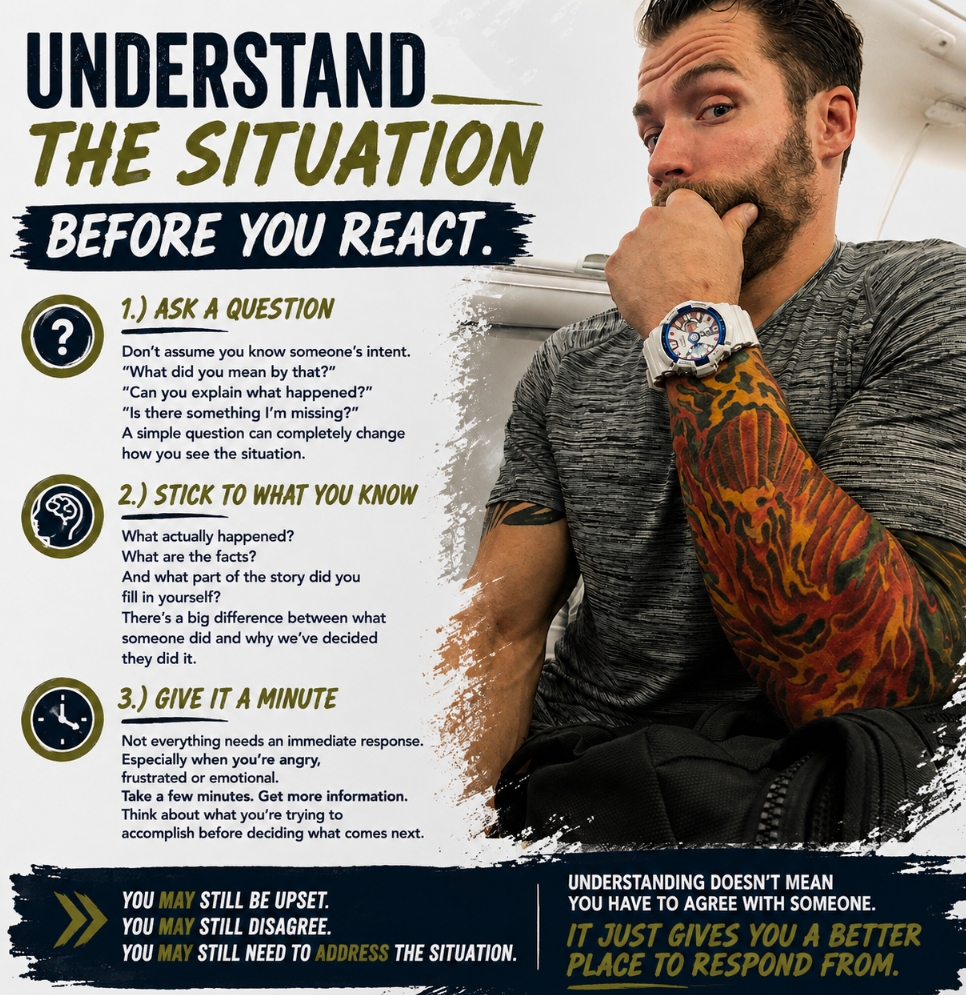
Before creating a narrative, ask questions.
Instead of:
“What’s wrong with them?”
Try:
“What might be going on that I don’t know about?”
Curiosity creates connection.
Assumptions create distance.
2. Listen to Understand, Not to Respond
Many leaders listen with the intent of finding a solution.
While problem-solving is important, it isn’t always what people need first.
Sometimes employees simply need to know someone is willing to hear them.
Listening is one of the most underutilized leadership skills because it requires patience.
It requires setting aside distractions.
It requires resisting the urge to interrupt.
Most importantly, it requires listening without immediately trying to fix the situation.
People often don’t remember every word a leader says.
They remember how that leader made them feel.
Feeling heard is one of the most powerful drivers of belonging in any workplace.
3. Hold Accountability and Compassion Together
A common misconception is that empathy means becoming soft.
It doesn’t.
Great leaders understand that accountability and compassion can coexist.
In fact, they should.
Empathy doesn’t mean accepting poor performance indefinitely.
It means understanding the circumstances while helping employees find a path forward.
The best leaders communicate:
“I understand what you’re facing, and I believe you’re capable of meeting this expectation.”
Notice the balance.
There is compassion.
There is support.
There is understanding.
But there is also accountability.
Employees thrive when they know leaders care about them as people while still believing in their ability to perform.
The Leadership Question That Changes Culture
Culture isn’t built during annual meetings.
It’s built in everyday conversations.
It’s built when leaders choose curiosity over judgment.
It’s built when they seek understanding before offering solutions.
It’s built when employees feel valued as human beings, not simply workers.
Before your next difficult conversation, pause and ask yourself one simple question:
“Am I trying to understand this person, or am I just reacting to the situation?”
That single question can change the tone of a conversation.
It can change the relationship between a leader and employee.
And over time, it can change the culture of an entire organization.
Because the best leaders don’t just manage performance.
They understand people.