When people start talking about emergency funds, you’ll usually hear something like:
“You should have three to six months of expenses saved.”
That’s a great goal. Eventually.
But let’s be realistic.
If you’re working your first job, living paycheck to paycheck, raising a family, or just trying to get your finances under control, someone telling you that you need $10,000 sitting in a savings account might as well tell you that you need $100,000.
You look at your paycheck. You look at your bills. You look back at that number and think, Yeah, that’s not happening.
So you don’t start at all.
That’s the problem.
Instead of worrying about having six months of expenses saved, let’s make the first goal much smaller.
Save your first $500.
That’s it.
Five hundred dollars isn’t going to protect you from every financial emergency. It’s not enough money to suddenly make you financially secure.
But it can create a little breathing room when life inevitably happens.
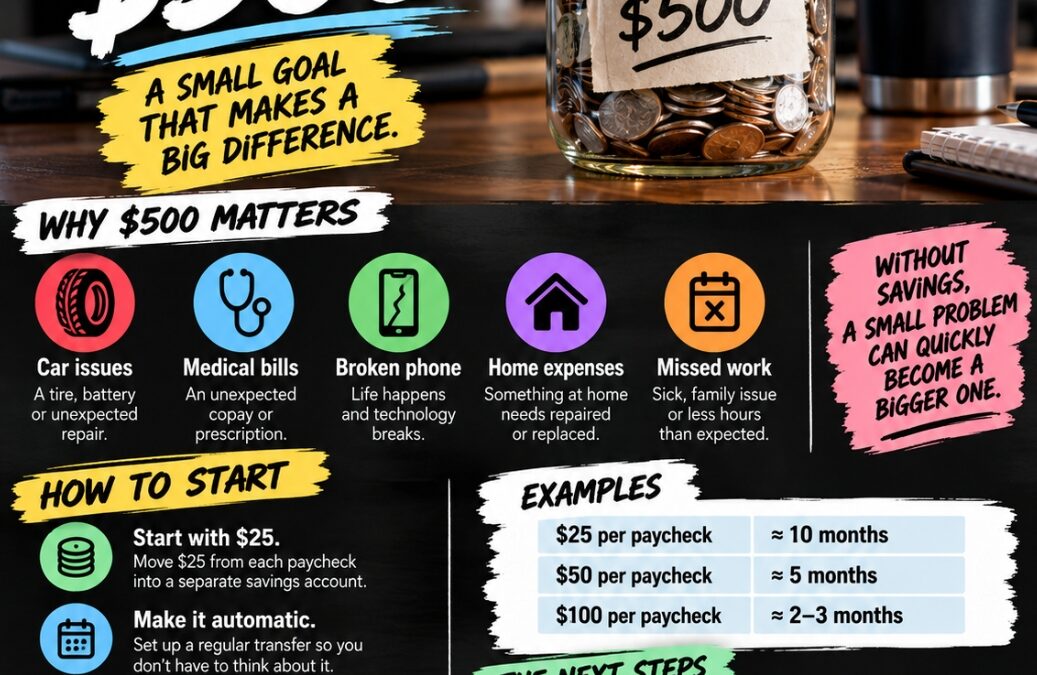
Your tire blows out on the way to work.
Your car needs a new battery.
You have an unexpected medical bill.
Your phone breaks.
Something in your house needs repaired.
You miss a couple of shifts because you or your child gets sick.
None of those situations are necessarily financial disasters.
Unless you have $0 available to deal with them.
That’s when a $300 problem can turn into a much bigger one.
Maybe the repair goes on a credit card you already can’t pay off. Maybe you borrow money from someone. Maybe you use a high-interest payday loan. Maybe you pay for the emergency but now don’t have enough money for another bill.
Suddenly, one problem has created two or three more.
That’s what we’re trying to prevent.
Having $500 doesn’t mean an unexpected expense won’t annoy you. Of course it will.
But there’s a big difference between saying, “Well, that sucks,” and saying, “I have absolutely no idea how I’m going to pay for this.”
That little bit of savings gives you options.
And here’s the important part:
You don’t need to save $500 tomorrow.
Start with $25.
If you get paid every two weeks and automatically move $25 from every paycheck into savings, you’ll have roughly $500 in about 10 months.
Make it $50 per paycheck and you’re there in about five months.
That’s a much more manageable goal.
Then look for opportunities to speed it up.
Pick up an extra shift? Put some of that money away.
Get birthday money? Save part of it.
Get a tax refund? You don’t have to spend all of it.
Sell something you don’t use anymore? Put the money into savings.
Even $5, $10 or $20 here and there moves you closer.
The trick is to stop thinking that saving only matters when you can save hundreds of dollars at a time.
Small amounts still count.
Another important part of this is keeping the money separate.
Your emergency fund isn’t your “there’s a concert this weekend” fund.
It’s not your DoorDash fund.
It’s not your vacation fund.
It’s definitely not your “I really want these shoes” fund.
Put it somewhere separate from the money you regularly spend so you aren’t constantly looking at that $500 and thinking about what you could buy with it.
It’s there for the things you didn’t plan for.
And eventually, something will happen and you’ll need to use it.
When that happens, you didn’t fail.
That’s exactly why you saved the money.
If you’ve worked for six months to build $500 and then have to spend $350 replacing two tires, don’t get discouraged because your account suddenly dropped back to $150.
You just paid for an unexpected expense without creating another financial problem.
That’s a win.
Handle the emergency. Then start building the account back up again.
Once you reach $500, set another goal.
$500 → $1,000 → one month of expenses → eventually three to six months.
You don’t have to get there this year.
You don’t even have to know exactly how you’re going to get there yet.
Just start.
Because financial stability usually isn’t created by one giant decision.
It’s built through hundreds of small decisions made consistently over time.
Twenty-five dollars might not feel like it’s changing your life today.
But the first time something goes wrong and you realize you already have the money to handle it?
You’ll understand exactly why you started.
Don’t get overwhelmed worrying about step ten when you haven’t taken step one.
Your first goal is $500.
Not because $500 solves everything.
Because $500 gives you something incredibly valuable when life happens:
Options.